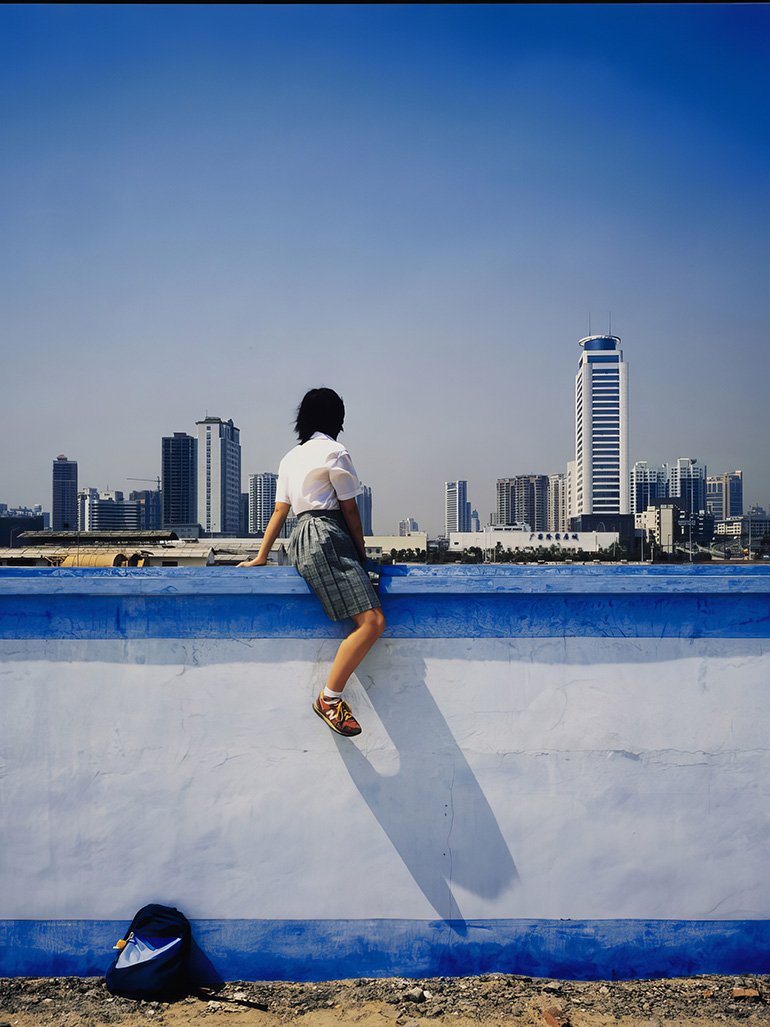
Weng Fen – Sitting on the Wall – Guangzhou (1), 2002-2003

Weng Fen – Sitting on the Wall – Guangzhou (3), 2002-2003

Weng Fen – Sitting on the Wall – Shenzhen (1), 2002-2003

Weng Fen – Sitting on the Wall – Shenzhen (1), 2002-2003

Weng Fen – Sitting on the Wall – Haikou (2), 2002-2003

Weng Fen – Sitting on the Wall – Haikou (4), 2002-2003

Weng Fen – Sitting on the Wall – Haikou (5), 2002-2003
The transitional phases and changes in China since its opening up in the 1980′s, both physically and emotionally, have been the source of inspiration for Weng Fen (b. 1961) and his work. In his earlier series Sitting on the Wall and Bird’s Eye View, Weng’s epic images focus on the upraising of urbanism in cities such as Haikou, Shanghai and Shenzhen. His subjects start out as outsiders looking into this overwhelming transformation with anticipation, fear and curiosity to being in the centre of it all. Weng then follows and evolves inwardly, shifting his attention from physical changes to emotional and spiritual transformations, from urban cities to rural countries, exploring the possibility of finding an otherworldly utopia, a place that may have existed all along in our hearts and minds, in our memories and those innocent times, which results in the acclaimed Staring at The Sea series.
Weng Fen has been exhibited worldwide in Asia, Europe and America, including the Pompidou Centre in Paris, the San Diego Museum of Art, the Shanghai Art Museum, the Taipei Museum of Contemporary Art, the Mori Museum in Tokyo, the Kunstmuseum Wolfsburg in Germany, the International Centre of Photography in New York and the Singapore Art Museum
Posted by publicdelivery
Posted January 30, 2013 9:00 am
Tags: 2002, 2003, photography.

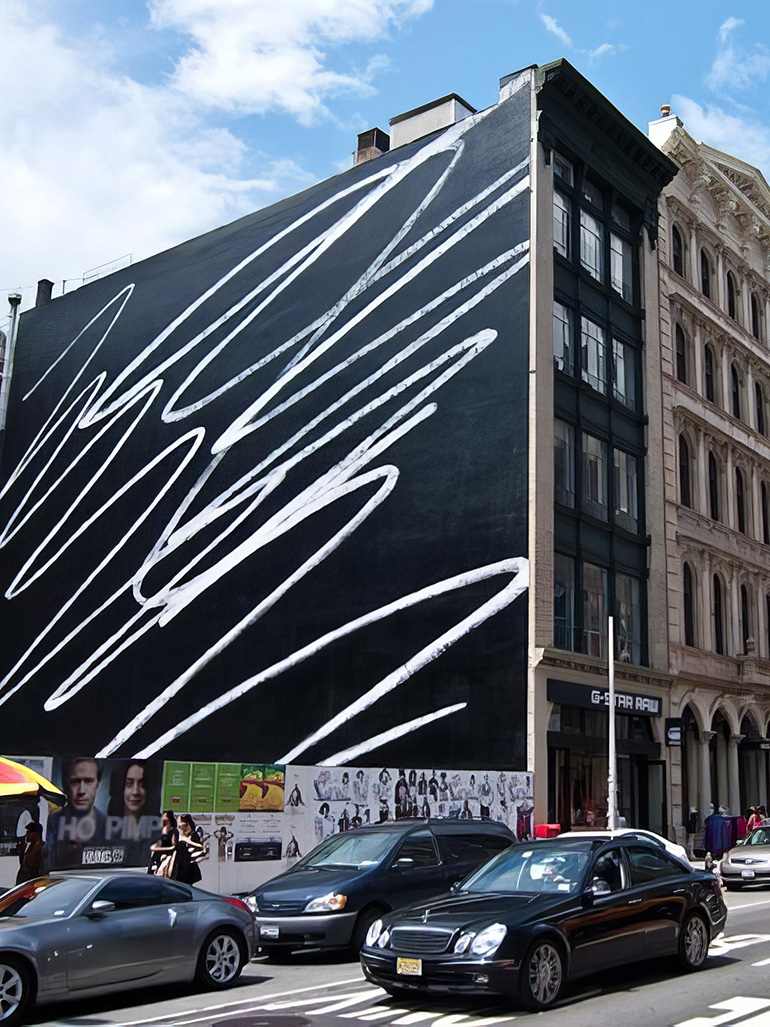
Karl Haendel – Scribble (digital rendering), NYC

Karl Haendel – Scribble, 2009, paint on brick, NYC

Karl Haendel – Scribble, 2009, paint on brick, NYC

Karl Haendel, Public Scribble #2, 2009, paint on brick, 5,5 x 19,5m, Los Angeles

Karl Haendel, Public Scribble #2, 2009, paint on brick, 5,5 x 19,5m, Los Angeles

Karl Haendel, Public Scribble #2, 2009, paint on brick, 5,5 x 19,5m, Los Angeles
In 2009, Los Angeles based artist Karl Haendel made two large scribble murals, one was his first public installation in New York, the other, a similar painting, was executed in Los Angeles. His gigantic scribbles are an anti heroic gesture with roots in street art, public mark making and a universal means of communication.
To put one of these scribbles on the side of a building of course engages a dialogue with graffiti and street art, and this became a central concern as well as an inspiration. My scribble work, because its an anonymous mark and one that anybody could make, I hope will draw attention to the simple need to make a mark, and I hope it makes people think about gesture, pure expression, and the straightforward act of creation. These are tendencies that I think are not only fundamental to art making, but to life in general, and are imperatives that most people I hope can relate to.
Karl Haendel (b. 1976) owns and individualizes the world of popular culture by re-drawing it in his own vision, cleverly manipulating scale, composition, and juxtaposition to uncannily transform ordinary images into witty perspectives on contemporary life. He received his MFA from UCLA in 2003 and has had solo exhibitions at the Museum of Contemporary Art, Los Angeles; Harris Lieberman, New York; Anna Helwing Gallery, Los Angeles. His work has also been included in such notable exhibitions as the 2004 and 2008 California Biennials and Uncertain States of America, a touring exhibition that originated at the Astrup Fearnley Museum for Modern Art, Oslo, and traveled to Serpentine Gallery, London, and the Center for Curatorial Studies, Bard College, among other venues.
Photos: #2: Michael Shaw, #4,5,6: Courtesy of the artist, LA><ART, Los Angeles and Kelly Barrie
Posted by publicdelivery
Posted January 28, 2013 9:00 am
Tags: 2009, Los Angeles, mural, NYC, public.
VIDEO
PHOTOS


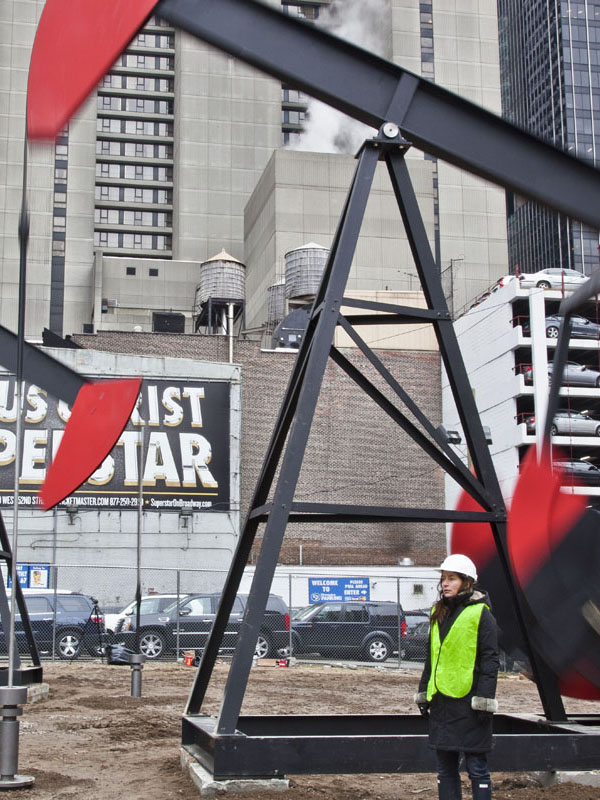
In March 2012, two monumental kinetic sculptures, each about 7.5m tall, transformed a disused public space in Midtown Manhattan into an art piece by Josephine Meckseper. Though mirroring the forms and materials of the mid-century oil industry, the artist locates her work firmly inside the contemporary debate about American business, wealth and consumerism.
The Manhattan Oil Project is inspired by mid 20th century oil pumps the artist discovered in Electra, a boarded-up town once famous for being the pump jack capital of Texas. Each sculpture is fully motorized to simulate the motions of a working oil pump. Placed in a vacant lot next to Times Square, the black and red steel structures slowly creak in the ceaseless oscillations of phantom oil excavation. The pump jacks recall the ruins of ghost towns, forgotten monuments of America’s decaying industrial past.
This pairing of the pump jacks and the Times Square location merges a classic symbol of American oil production and wealth with the center of New York City commercial culture. The pumps are intended as ignition points for critical discussion engaged directly with modern life, as opposed to operating in the realm of disengaged abstract geometries. They evoke speculation about a functional reality and the notion of use value. I hope to draw parallels between the American industrial system, transitioning from a past of heavy industry, factories, and teamsters and the disembodied present of electronic mass-media, surface advertising, and consumerism – so clearly embodied in Times Square, explained Meckseper, The critical placement of the pumps is a conceptual gesture that raises questions about business and capital; land use and resources; wealth and decay; decadence and dependence.
Josephine Meckseper (b. 1964) has developed a practice which melds the aesthetic language of modernism with a profound critique of consumerism. Through her shop windows, vitrines, installations, photographs, films and magazine projects she draws a direct correlation to the way consumer culture defines and circumvents subjectivity and sublimates the key instruments of individual political agency. Her works have been included in international biennials such as the Whitney Biennial, the Second Moscow Biennial of Contemporary Art and Biennale d’Art Contemporain de Lyon. She has also had solo exhibitions at the Migros Museum für Gegenwartskunst (Zürich, Switzerland), Ausstellungshalle zeitgenössische Kunst (Münster, Germany) and a retrospective at the Kunstmuseum Stuttgart. Her work was featured at the Museum of Modern Art in New Photography and at the Guggenheim Museum, New York.
Photos by James Ewing, courtesy of Art Production Fund
Video
Photos

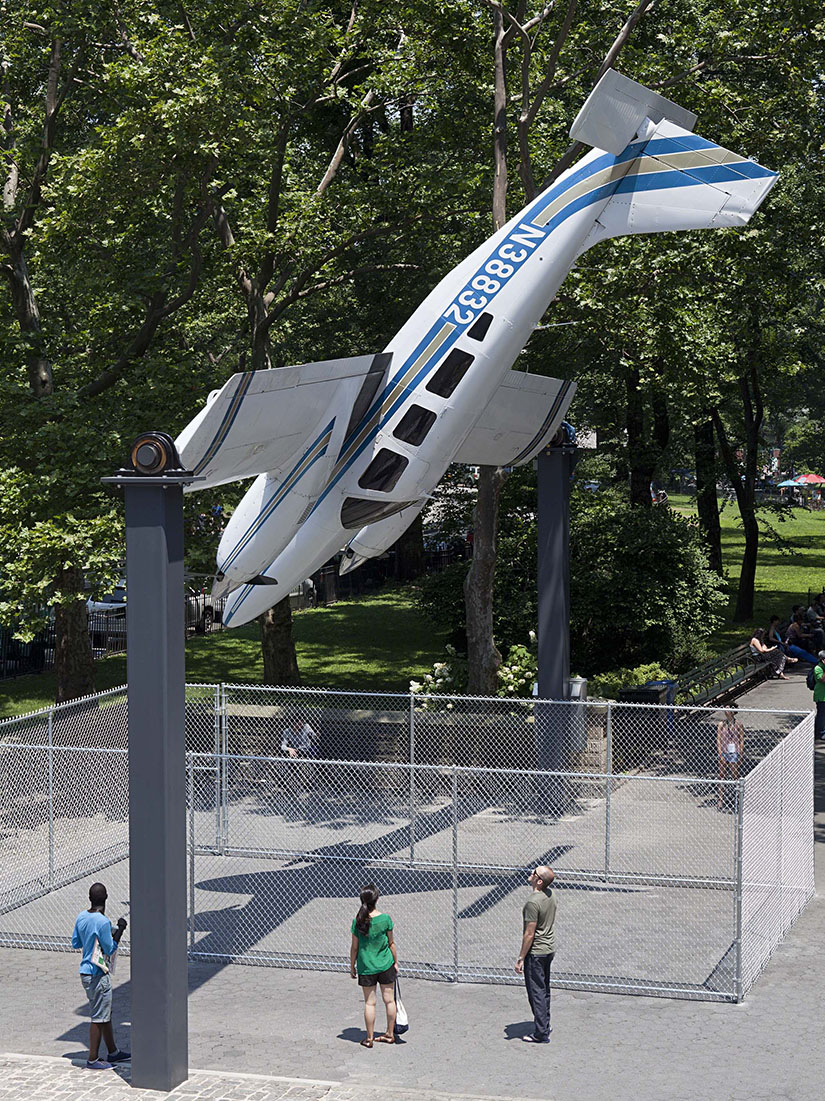
How I Roll, 2012; Rotating Piper Seneca, steel supports, motor

How I Roll, 2012; Rotating Piper Seneca, steel supports, motor
For two months a small air plane was rotating 24 hours a day in summer 2012 in Central Park, NYC. Previous works by Paola Pivi have also featured large machines, including an overturned tractor-trailer and a helicopter placed upside down.
Born in Milan, Italy, in 1971 and now based in Anchorage, Alaska, Paola Pivi’s diverse artistic practice embraces sculpture, photography, video, and performance. How I Roll is Pivi’s first public commission in the United States.
(Photos by Attilio Maranzano, via)


Live at the Museum is Public Delivery’s next big project, done together with Andre Hemer. It is an international performance project and an on-going series of video works. So far it has been shot in various locations on four different continents.
More information next month, stay tuned!
Posted by publicdelivery
Posted January 21, 2013 9:00 am
Tags: 2011, 2012, Andre Hemer, performance, public, Public Delivery, video.

Filippo Minelli – Silence: Lines, 2010

Filippo Minelli – Silence: Lines, 2010

Filippo Minelli – Silence: Lines, 2009

Filippo Minelli – Silence: Lines, 2009

Filippo Minelli – Silence: Lines, 2009
Silence: Lines is an on-going series of works by Filippo Minelli, and shares a similar idea like his smoke bomb photos. The line is a tool that is normally used in writing to say nothing. It represents silence and interacts with the urban and rural surrounding in a drastic way without changing it’s own nature. In Chinese culture the horizontal line represents the primordial breath, the separation between earth and sky and shows separation and unity at the same time, portraying the cycle that rules everything on the planet.
Photos above are taken in various locations around Europe in 2009-2011.
> see more Silence: Lines works on Public Delivery
Posted by publicdelivery
Posted January 18, 2013 9:00 am
Tags: 2009, 2010, Filippo Minelli, photography, public.


Not much information can be found about Sunghee Lee, a French based photographer, and his work, but his empty billboard photos quickly remind of Bernd and Hilla Becher and their Neue Sachlichkeit (New Objectivity). However, he is using various angles and distances and usually contextualizes his objects with the surroundings and small events like a passing person or taxi.
Posted by publicdelivery
Posted January 16, 2013 9:00 am
Tags: photography, public.